Version dys (adapted layout, same C1 content)
C1 · Première and Terminale généralesSession 2. The girl who was not meant to reign
A painting of 1933, an abdication in 1936, a family tree, and a princess in uniform.
55 minutes: Recap 5 min · Point du professeur 10 min · Document 8 min · Vocabulary 7 min · Grammar 12 min · Figures and idioms 6 min · Task 7 min
What we already know
- A profile, a likeness, a sitter; flattering and unflattering.
- Present simple and continuous; stative verbs; deduction with must, might, can't.
- Understatement: "Age is rarely kind to anyone."
Quick quiz (one point each)
- Give the opposite of "flattering".
- Correct: She is knowing the truth.
- "I'm sure he is lying" becomes...
Answers
- unflattering
- She knows the truth.
- He must be lying.
1Le point du professeur10 min
Pour raconter une enfance qui bascule, les élèves ont besoin du prétérit simple (faits successifs), du prétérit progressif (arrière-plan), de used to et would (habitudes passées) et du futur dans le passé (was going to, would, was to) pour dire ce qui n'était pas prévu. On part de l'arbre généalogique : Nobody expected that she would become Queen.
Starting point
In 1933 Elizabeth was seven. She was sitting for a portrait painter. Nobody thought she would ever be Queen.
Past simple vs past continuous
- Completed events in sequence: Edward VIII abdicated and her father became King.
- Background or interrupted action: She was playing at home when the news arrived.
Past habits: used to / would
- She used to live at 145 Piccadilly (state: only used to).
- She would ride her ponies every weekend (repeated action: would or used to).
The future in the past
- was going to: a plan seen from the past. Edward was going to marry Wallis Simpson.
- would: a prediction seen from the past. Nobody knew she would reign for 70 years.
- was to: destiny. She was to become the longest-reigning monarch in British history.
2The document8 min
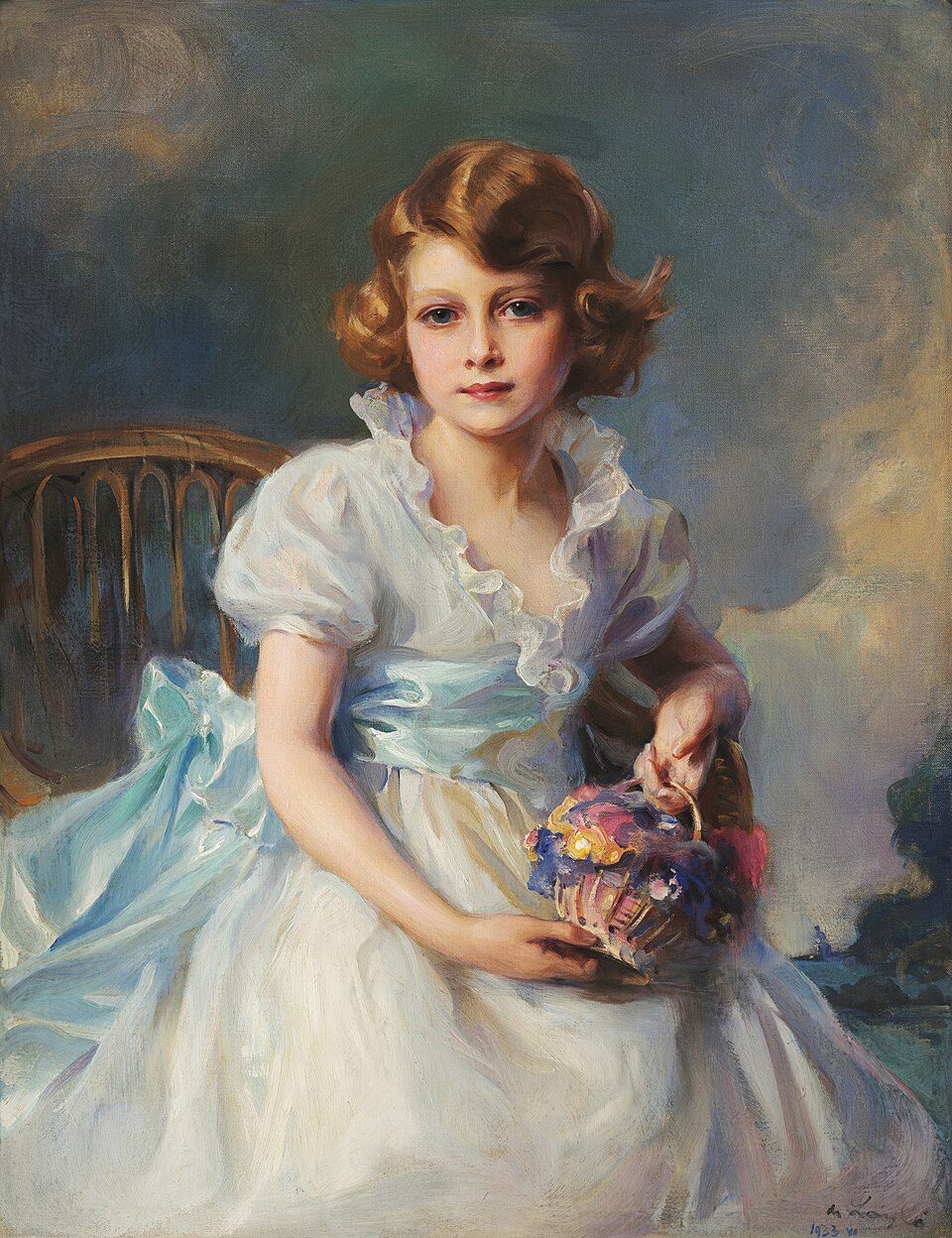
The facts. Princess Elizabeth of York was born on 21 April 1926, the elder daughter of the Duke of York, the King's second son. She was third in line to the throne, and it was widely expected that her uncle, the Prince of Wales, would marry and have children. Philip de László painted her in 1933, when she was seven; her father had commissioned the portrait.
In January 1936 George V died and her uncle became Edward VIII. In December 1936 he abdicated in order to marry Wallis Simpson, an American who had been divorced twice. Elizabeth's father became King George VI, and the ten-year-old princess became heir presumptive.
On her 21st birthday, 21 April 1947, in a radio broadcast from Cape Town, she said:
The official Season 1 trailer (2016) presents Claire Foy as the young Queen "who took the throne as a matter of duty not desire", in Netflix's own words.
Understanding the document
- Who commissioned the portrait, and when?
- Describe the portrait: setting, clothes, colours, mood.
- Why was she not expected to reign?
- What happened in December 1936?
- What did she promise in 1947? Which verb form in the quotation is unusual?
- What is surprising about her war service?
Answers
- Her father, the Duke of York (later George VI), in 1933.
- A seven-year-old girl with fair curls in a white dress with a blue sash, seated outdoors with a basket of flowers; soft light, gentle colours, a private, childlike mood, not a state portrait.
- Her father was the second son; her uncle, the Prince of Wales, was expected to marry and have children of his own.
- Edward VIII abdicated to marry Wallis Simpson; her father became George VI and she became heir presumptive.
- To devote her whole life to the service of the Commonwealth. "Whether it be" is a subjunctive (formal).
- A princess trained as an army driver and mechanic in 1945.
3Building your vocabulary
| Word | Meaning |
|---|---|
| an heir apparent | an heir who cannot be displaced (a monarch's eldest child, today) |
| an heir presumptive | an heir who could be displaced by the birth of a closer heir |
| the line of succession | the order in which heirs inherit the throne |
| to abdicate, an abdication | to give up the throne |
| to accede to the throne, an accession | to become monarch |
| to succeed somebody, a successor | to come after somebody in a position |
| to be groomed for | to be prepared over time for a role |
| to commission a portrait | to order and pay for a portrait |
| a subaltern | a junior army officer |
| to pledge, to devote oneself to | to promise solemnly, to give one's life to |
Exercise 1. Definitions
Which word is it?
- To give up the throne.
- An heir who could be displaced by a closer heir.
- To come after somebody in a position.
- To order and pay for a portrait.
- A junior army officer.
- To be prepared over time for a role.
- The order of the heirs.
Answers
- to abdicate
- an heir presumptive
- to succeed somebody
- to commission
- a subaltern
- to be groomed for
- the line of succession
Exercise 2. Word families
Complete the table: verb, noun.
- to abdicate
- to succeed
- to accede
- to devote
- to inherit
Answers
- an abdication
- a succession, a successor
- an accession
- devotion
- an inheritance, an heir
4Grammar in practice
From recognition to open production.
RecognitionExercise 3. Identify the form
Name the verb form in bold: past simple, past continuous, used to, would (habit), future in the past.
- She was sitting in a garden chair.
- Edward VIII abdicated in December 1936.
- The princesses used to live at 145 Piccadilly.
- Every morning she would feed the corgis.
- Nobody knew she would reign for seventy years.
- She was to become Queen at 25.
Answers
- past continuous
- past simple
- used to (past state)
- would (habit)
- future in the past
- future in the past (destiny)
Controlled practiceExercise 4. Past simple or past continuous?
Put the verbs in the correct form.
- Elizabeth (play) ______ when she (hear) ______ the news.
- While the painter (work) ______, the girl (try) ______ to keep still.
- In 1945 she (join) ______ the ATS.
- She (learn) ______ to change wheels while other cadets (study) ______ map reading.
- George VI (die) ______ on 6 February 1952 while she (travel) ______ in Kenya.
Answers
- was playing, heard
- was working, was trying (tried)
- joined
- was learning, were studying
- died, was travelling
TransformationExercise 5. The future in the past
Rewrite with the words given.
- "I will marry Wallis," Edward said. (was going to)
- People expected: "Edward will have children." (would)
- Destiny: she became the longest-reigning British monarch. (was to)
- "I'll be Queen one day," she realised. (would)
Answers
- Edward was going to marry Wallis.
- People expected that Edward would have children.
- She was to become the longest-reigning British monarch.
- She realised she would be Queen one day.
TransformationExercise 6. Used to or would?
Choose; sometimes both are possible.
- She ______ have a pony called Peggy.
- Every Sunday they ______ walk in Windsor Great Park.
- Her governess, Marion Crawford, ______ teach her at home.
- The family ______ live in Piccadilly before 1936.
Answers
- used to (state of possession)
- would / used to
- would / used to
- used to
AccuracyAccuracy check. Find the mistake
Each sentence contains one mistake. Find it and correct it.
- Elizabeth was born in 1926 and was becoming Queen in 1952.
- While she played in the garden, the news arrived.
- Nobody knew in 1930 that she will become Queen.
- Edward VIII has abdicated in December 1936.
- As a child, she didn't used to go to school.
- Her father was going to never be king.
Answers
- Elizabeth was born in 1926 and became Queen in 1952.
- While she was playing in the garden, the news arrived.
- Nobody knew in 1930 that she would become Queen.
- Edward VIII abdicated in December 1936.
- As a child, she didn't use to go to school. (she was taught at home)
- Her father was never going to be king.
Open productionExercise 7. The day everything changed
Write 12 to 15 lines from the point of view of Elizabeth, aged ten, on 11 December 1936. Use the past simple and continuous, two past habits (used to, would) and three forms of the future in the past.
Help: begin "I used to think that..." then "Today, everything changed when...".5Figures of speech
- Antithesis: opposed ideas side by side. a little girl / a sovereign; private childhood / public destiny.
- Hyperbole, solemn style: "my whole life ... shall be devoted to your service".
- Archaism: "whether it be long or short" (subjunctive), giving gravity to a promise.
Exercise 8. Spot the figure
Antithesis, archaism or hyperbole?
- "whether it be long or short"
- "a girl in a garden, a Queen in an abbey"
- "I've told you a million times!"
- "my whole life ... shall be devoted"
Answers
- archaism (subjunctive)
- antithesis
- hyperbole
- solemn hyperbole (and the archaic modal shall)
6Idioms
born into a rich, privileged family.
Silver spoons were a traditional christening gift in wealthy families.
Elizabeth was born with a silver spoon in her mouth, yet her future was uncertain.
an unexpected change in one's life.
Figurative use of "twist" (a sudden turn).
By a twist of fate, the second son became King.
to take over somebody's role.
The image of wearing another person's shoes.
George VI had to step into his brother's shoes.
to face a difficult task without preparation.
From swimming pools: the deep end is where you can't touch the bottom.
She was thrown in at the deep end at 25.
Exercise 9. Choose the idiom
Complete.
- He didn't have to work for money: he was ______.
- When the manager left, Anna had to ______.
- By ______, the princess became heir presumptive.
- On my first day at work I was ______: no training at all.
Answers
- born with a silver spoon in his mouth
- step into his shoes
- a twist of fate
- thrown in at the deep end
7Expression task7 min
A family tree, told aloud. Using the tree (part A), explain to your partner in 90 seconds how the crown passed from George V to Elizabeth II. Use at least: was succeeded by, abdicated, would become, had been, was going to.
- Past continuous or simple: She (drive) ______ an army lorry when the photographer (arrive) ______.
- Future in the past: Nobody knew she ______ (reign) for 70 years.
- Heir apparent or heir presumptive: Elizabeth in 1937?
Answers
- was driving, arrived
- would reign
- heir presumptive
C1+Going further (towards C2)
Read and react (C1+). In 1947 the princess speaks of "our great imperial family". In 150 words, explain how this phrase sounds today, and how the Empire became the Commonwealth. Use was to, would and one mixed conditional.
Language point: the formal subjunctive survives in set phrases: be that as it may, come what may, God save the King, so be it. Use two of them in sentences about the abdication.
HWHomework
Learn the succession vocabulary. Write a 12-line biography of Edward VIII or George VI using six different past forms, then check every date in the Family trees page.