Session 6. Portraits as power: from Gloriana to a Queen in colour
Tudor icons, a Victorian state portrait, a primrose-yellow investiture, and a wardrobe that was a portrait in itself.
55 minutes: Recap 5 min · Point du professeur 10 min · Document 8 min · Vocabulary 7 min · Grammar 12 min · Figures and idioms 6 min · Task 7 min
- an allegory: an image with a hidden meaning
- the regalia: symbols of royalty
- a hue, a shade: a colour, a variety of a colour
- eye-catching: easy to notice
- to stand out: to be very visible
What we already know
- Past perfect, past modals, third and mixed conditionals, I wish / If only.
- Aberfan, 21 October 1966; the Queen visited on 29 October.
- A stiff upper lip; to put on a brave face.
Quick quiz (one point each)
- Reproach: She didn't go at once. → She ______.
- Mixed conditional: If the Board (listen) ______, Aberfan (be) ______ different today.
- Meaning of "a stiff upper lip"?
Answers
- should have gone at once
- had listened, would be
- hiding one's emotions
1Le point du professeur10 min
Pour analyser des portraits qui traversent les siècles et une garde-robe qui a duré soixante-dix ans, les élèves ont besoin du present perfect simple et progressif (bilan, durée jusqu'à aujourd'hui) en opposition avec le prétérit (date passée). On part de : Monarchs have always used portraits. Elizabeth I was painted in 1588. On ajoute le lexique des couleurs et de la mode.
Starting point
Rulers have used portraits for centuries. Elizabeth I was painted with a globe in about 1588. Historians have been studying these images ever since.
Present perfect simple vs past simple
- Present perfect: link with now, no finished time. The Armada Portrait has been restored (result visible today). Have you ever seen it?
- Past simple: finished time. It was restored in 2016 and 2017.
Present perfect continuous: duration and activity
Royal Museums Greenwich has been showing the portrait since its restoration. Fashion historians have been writing about her hats for decades.
Since / for / ever / yet / already / just
since 1588, for over four centuries; I have just discovered the four-leaf clover; Have you visited the Queen's House yet?
2The document8 min
A. Painted power
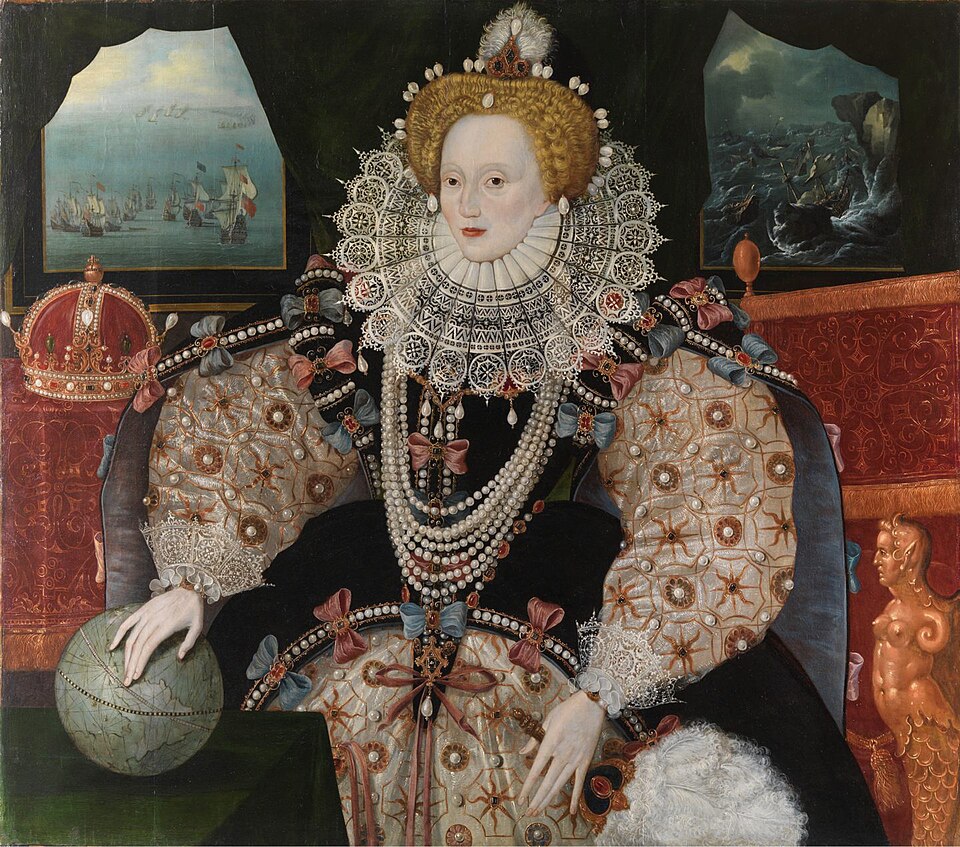
- The Armada Portrait (about 1588): Elizabeth I rests her hand on a globe; behind her, the Spanish Armada sails in calm and then in storm. Power over the seas, painted as destiny.
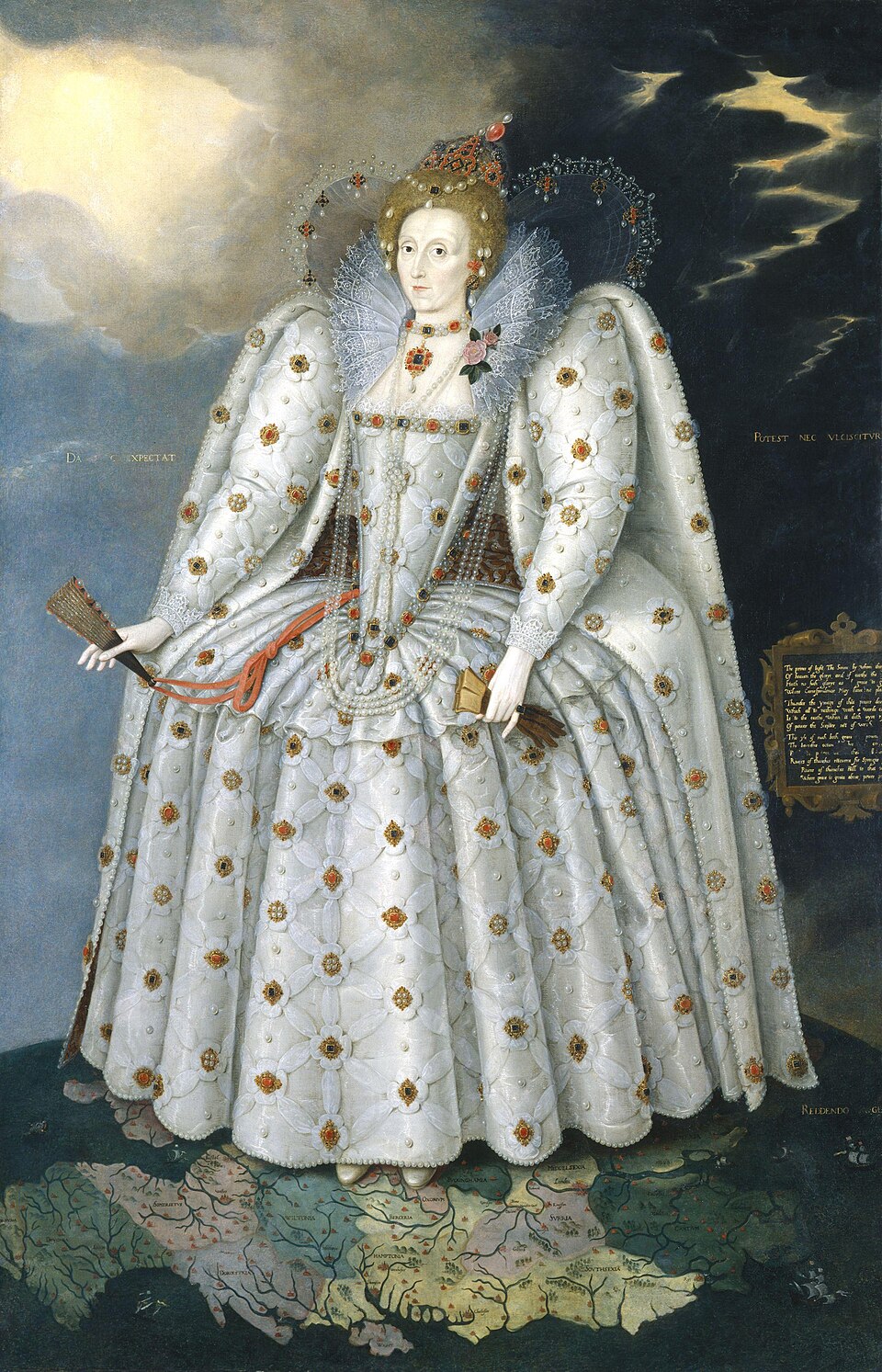
- The Ditchley Portrait (about 1592): commissioned by Sir Henry Lee, it shows the Queen standing on a map of England, with storm clouds on one side and sunshine on the other. She literally rules the land.
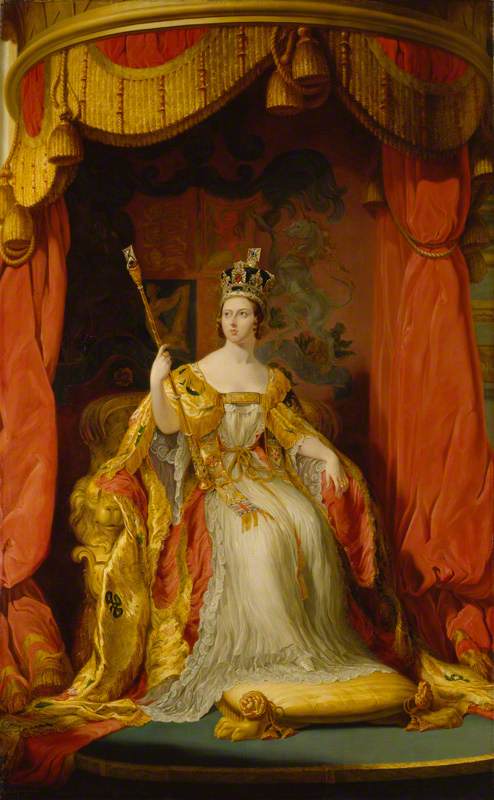
- Hayter's Queen Victoria (state portrait, 1838): the young Victoria in coronation robes, crowned and seated, holding the sceptre.
These images construct what historians call the mask of youth: an ageless, idealised Queen, very far from the truth Sutherland or Freud would later paint.
B. A Queen in colour
Elizabeth II was famous for bright, single-colour coats with matching hats. The reason was practical: she had to be seen. Her daughter-in-law Sophie, then Countess of Wessex, explained in the documentary The Queen at 90 (2016):
Little-known facts about the royal wardrobe. Each one is checked: follow the link.
- A dress paid for with ration coupons. In 1947 clothes were still rationed. Norman Hartnell designed Princess Elizabeth's wedding dress, inspired by Botticelli's Primavera as a symbol of rebirth after the war. On 22 October 1947 the House of Commons was told that "one hundred coupons have been issued to Princess Elizabeth for her wedding" (Hansard); the Royal Collection Trust gives the figure of 200 additional coupons (Royal Collection Trust). Brides from all over the country sent her their own coupons, which had to be returned: giving them away was illegal (BBC News, 2007).
- Curtain weights in the hems. Her couturier Stewart Parvin explained how her skirts never blew up in the wind: "I use curtain weights, lead weights, from Peter Jones's curtain department. We call them penny weights. I just pop a couple into the hemline of her dresses and coats and it makes them hang beautifully." (Daily Mail)
- Angela Kelly. The Liverpool-born daughter of a seamstress, she joined the Household in 1994 as one of the Queen's dressers, and by 2001 she was designing the Queen's outfits herself. Because they took the same shoe size, she wore in the Queen's new shoes. Her book The Other Side of the Coin (2019) was published with the Queen's permission (Vogue).
- The handbag. The London firm Launer received a Royal Warrant from the Queen in 1968, after supplying her bags for five years, and held it for more than fifty years (Launer London).
- Neon at 90. For Trooping the Colour on 11 June 2016, marking her 90th birthday, she wore a vivid lime-green coat and dress by Stewart Parvin with a matching hat by Rachel Trevor Morgan; it immediately trended online as #neonat90 (Evening Standard; The Telegraph).
- A wardrobe in a museum. In 2016 the Royal Collection Trust devoted an exhibition in three royal residences to her clothes: Fashioning a Reign: 90 Years of Style from The Queen's Wardrobe.
C. Primrose yellow at Caernarfon, 1 July 1969
Prince Charles had been created Prince of Wales by Letters Patent in 1958; his investiture took place at Caernarfon Castle on 1 July 1969, watched by millions on television. It was not a coronation: there was no anointing and no crowning of a sovereign. The title already existed in law; the ceremony was symbolic. The Letters Patent were read in Welsh, and the Queen invested her son with the insignia: a sword, a coronet, a ring, a gold rod and a mantle. Charles knelt, placed his hands between hers and swore to be her "liege man of life and limb". (College of Arms; HistoryExtra)
The Queen wore a pale primrose-yellow silk crepe coat and matching tunic embroidered with pearls and bugle beads, and a hat by the French-born milliner Simone Mirman that covered the back of the head to the nape. The Royal Collection Trust says the hat "appears to have been inspired by Tudor prototypes" (Royal Collection Trust). The coat was designed by Norman Hartnell, who nicknamed the hat her "medieval helmet" (People).
Think about it. The Tudor dynasty had Welsh roots: Henry VII was born at Pembroke Castle in Wales in 1457. Why might a Tudor-style hat be a clever choice at a Welsh ceremony?
The series tells the story in Season 3, Episode 6, "Tywysog Cymru" ("Prince of Wales" in Welsh). Charles really learned Welsh at Aberystwyth before the ceremony, but the episode's secret, defiant speech is invented.
Understanding the document
- In the Armada Portrait, what does the globe suggest?
- In the Ditchley Portrait, why does the Queen stand on a map?
- What is the "mask of youth"?
- Why did Elizabeth II wear bright colours, according to the Countess of Wessex?
- How did her couturier stop her skirts from blowing up in the wind?
- Why was the 1969 investiture not a coronation?
- Which insignia did the Queen present?
- How could the hat be read as a message?
Answers
- Power over the world and the seas, after the defeat of the Armada.
- To show that she rules and protects England; storm and sunshine suggest she brings peace after danger.
- The ageless, idealised face of official royal portraits.
- So that crowds could see her and say "I saw the Queen".
- Stewart Parvin sewed small lead curtain weights from Peter Jones into the hems of her dresses and coats.
- No anointing, no crowning of a sovereign; the title already existed by Letters Patent; the ceremony was symbolic.
- A sword, a coronet, a ring, a gold rod and a mantle.
- Tudor style, and the Tudors had Welsh roots: a nod to Wales at a Welsh ceremony.
3Building your vocabulary
Colour and fashion
| Word | Meaning |
|---|---|
| a hue, a shade, a tone | a colour, a variety of a colour (a pale shade of yellow) |
| bold, vivid, bright / muted, pastel | strong colours / soft colours |
| eye-catching, striking | easy to notice |
| to stand out, to blend in | to be very visible / to be hard to see |
| to clash, to match, to coordinate | to look bad together / to look good together |
| a splash of colour | a small bright area of colour |
| colour-blocking | wearing one strong colour from head to toe |
| a milliner, millinery | a hat maker; hats |
| a couturier, a dresser | a fashion designer; a person who looks after somebody's clothes |
| embroidered with, beaded | decorated with stitching, with beads |
Painting and power
an allegory, a symbol, the regalia, the foreground, the background, to convey, to idealise, propaganda, a state portrait, the insignia, an investiture.
Exercise 1. Colour words
Complete with: clash, stand out, splash, shade, matching, muted.
- She chose a coat with a ______ hat.
- Bright colours helped her ______ in a crowd.
- Orange and pink can ______.
- Primrose is a pale ______ of yellow.
- Add a ______ of colour with a scarf.
- Beige, grey and taupe are ______ colours.
Answers
- matching
- stand out
- clash
- shade
- splash
- muted
Exercise 2. Describe an outfit
Put the words in the right order.
- hat / a / silk / yellow / pale
- coat / wool / blue / bright / a
- an / dress / embroidered / ivory
- green / hat / lime / a / matching
Answers
- a pale yellow silk hat
- a bright blue wool coat
- an embroidered ivory dress (ivory embroidered dress)
- a matching lime-green hat
4Grammar in practice
From recognition to open production.
RecognitionExercise 3. Present perfect or past simple?
Why is each form used?
- The portrait was painted in about 1588.
- The portrait has been restored.
- Fashion historians have been studying her wardrobe for years.
- She wore lime green in 2016.
Answers
- past simple: finished date
- present perfect: result visible now
- present perfect continuous: duration up to now
- past simple: finished time
Controlled practiceExercise 4. Choose the tense
Present perfect simple, continuous or past simple?
- The Royal Collection (show) ______ her dresses many times.
- In 1969 she (wear) ______ primrose yellow.
- Visitors (queue) ______ for hours to see the exhibition.
- I (never / see) ______ the Ditchley Portrait.
- Elizabeth I (rule) ______ for 44 years.
- Since 1588, the Armada Portrait (become) ______ an icon.
Answers
- has shown
- wore
- have been queuing (if still now) / queued (if finished)
- have never seen
- ruled
- has become
TransformationExercise 5. Rewrite
Use the words given.
- I started studying these portraits two weeks ago. (for)
- The last time I saw her hat was in 2016. (since)
- This is my first visit to Caernarfon. (never)
- They began restoring the portrait in 2016. (since)
Answers
- I have been studying these portraits for two weeks.
- I haven't seen her hat since 2016.
- I have never been to Caernarfon before.
- They have been restoring the portrait since 2016. (or: it has been restored since...)
AccuracyAccuracy check. Find the mistake
Each sentence contains one mistake. Find it and correct it.
- The Armada Portrait has been painted in about 1588.
- Monarchs use portraits for centuries.
- I study these portraits since September.
- How long do you know this painting?
- Elizabeth I has died in 1603.
- The museum has been showing the dresses three times this year.
Answers
- The Armada Portrait was painted in about 1588.
- Monarchs have used portraits for centuries.
- I have been studying these portraits since September.
- How long have you known this painting?
- Elizabeth I died in 1603.
- The museum has shown the dresses three times this year. (a number of times: simple form)
Open productionExercise 6. A wardrobe as a portrait
Write a 180-word museum label for one of her outfits (choose: the coronation dress 1953, primrose yellow 1969, lime green 2016). Use the present perfect simple and continuous, the past simple, five colour or fashion words and one colour idiom.
Help: "This dress has been shown...", "She wore it in...", "It has become...".5Figures of speech
- Allegory: the storm and the sunshine in the Ditchley Portrait.
- Synecdoche: "a bit of the Queen's hat": the hat stands for the Queen.
- Symbol: the globe, the map, the Tudor hat.
Exercise 7. Interpret
Explain each symbol in one sentence.
- A hand on a globe.
- Standing on a map.
- One bright colour from head to toe.
- A Tudor-style hat in Wales.
Answers
- Power over the world, especially the seas.
- Ruling and protecting the land.
- Being visible to everybody: a public role.
- A link with the Tudors' Welsh origins.
6Idioms
to reveal one's real character.
From ships that sailed under false flags (colours) and showed their real flag before attacking.
In a crisis people show their true colours.
a very special, memorable day.
Feast days were marked in red in old church calendars.
1 July 1969 was a red-letter day for Caernarfon.
completely unexpectedly.
Like thunder from a clear blue sky.
The news came out of the blue.
very jealous.
Shakespeare calls jealousy "the green-eyed monster" in Othello.
Other guests were green with envy at her hat.
in very good health.
An old expression meaning "in the best condition".
At 90 she was still in the pink.
to become very angry.
Often linked to bulls and red capes, though bulls cannot see red.
He saw red when he saw his portrait.
Exercise 8. Colour idioms
Complete.
- My grandmother is ninety and still ______.
- When he read the review, he ______.
- The offer came completely ______.
- Her friends were ______ when she got the job.
- Graduation day is a ______.
- When things went wrong, he ______ and left.
Answers
- in the pink
- saw red
- out of the blue
- green with envy
- red-letter day
- showed his true colours
7Expression task7 min
Curator for a day. In groups, prepare a two-minute guided tour of one portrait (Armada, Ditchley, Hayter) or one outfit (1953, 1969, 2016). Include symbols, colours, one present perfect continuous and one colour idiom.
- Present perfect or past: She (wear) ______ primrose yellow in 1969.
- A word meaning "to look bad together" (colours).
- Why was 1969 not a coronation?
Answers
- wore
- to clash
- No anointing, no crowning of a sovereign: Charles was invested as Prince of Wales.
C1+Going further (towards C2)
Fashion as diplomacy (C1+). The Queen often chose colours or emblems linked to the country she visited, as on her coronation dress. In 250 words, analyse clothes as a political language, using the present perfect, two sentence adverbs (arguably, notably) and three colour idioms. Compare with Elizabeth I's portraits.
HWHomework
Learn the colour and fashion vocabulary and the six colour idioms. Describe in 12 lines a photograph of the Queen you find online (give the link, do not copy the picture): colours, hat, occasion, message.